I was able to understand a little better the words in some of the tune's remixes: What I took to be "who's gonna be the best of..." is actually "who's gonna ease the pressure of...". Why, of course! I'm still hoping to resolve a couple of SAUNZ in my lyric transcription.
Saturday, April 21, 2012
Shazam
On 27 June 2010, I asked for help identifying a particular piece of music. Today I managed to find out — well, because there's an app for that! The song turns out to be Mac Thornhill's 1988 Who's Gonna Ease The Pressure:

Friday, April 20, 2012
Eight
845534401, 83565065201, 829144019201, 834854554601, 854516148301, 866422665701, 878554044001, 889419071111, 890750408711, 891079866601, ...
Each of these is a prime equal to a multiple of its reversal plus-or-minus a prime smaller than itself in exactly 8 ways (A182239). For example:
845534401 = 104435548 * 3 + 532227757
= 104435548 * 5 + 323356661
= 104435548 * 6 + 218921113
= 104435548 * 8 + 10050017
= 104435548 * 9 - 94385531
= 104435548 * 11 - 303256627
= 104435548 * 14 - 616563271
= 104435548 * 15 - 720998819
All ten of our numbers begin with an 8. What will be the first term that does not?
Each of these is a prime equal to a multiple of its reversal plus-or-minus a prime smaller than itself in exactly 8 ways (A182239). For example:
845534401 = 104435548 * 3 + 532227757
= 104435548 * 5 + 323356661
= 104435548 * 6 + 218921113
= 104435548 * 8 + 10050017
= 104435548 * 9 - 94385531
= 104435548 * 11 - 303256627
= 104435548 * 14 - 616563271
= 104435548 * 15 - 720998819
All ten of our numbers begin with an 8. What will be the first term that does not?
Thursday, April 19, 2012
Galway, England
My father-in-law, John Edward Powers, likes to play up his Irish roots, even though his mother's parents were both born in France, his father's mother, Agnes Sullivan, born in Toronto ON, and his father's father, David Edward Powers, born in Sandy Creek NY. Agnes Sullivan's parents may have come from northern Ireland but David Edward Powers' parents were from county-unknown. So the genealogically-minded members of the Powers clan were excited, last year, to find David Edward's uncle, Michael Powers. At the time, I asked John if he knew anything about his Irish roots. A new priest at his church had asked him the same thing and John had to admit that he did not know. But in the following days he thought about it and a word came to him (from, hopefully, his parents/grandparents and not some movie that got stuck in his mind). The word was Connemara.
Two-and-a-half weeks ago, Marlene Frost shared with me her discovery of an obituary for Michael Powers that mentioned his place of birth: Galway, Ireland. Yesterday, I found another one that (sort-of) confirmed the location. We're making progress!
Two-and-a-half weeks ago, Marlene Frost shared with me her discovery of an obituary for Michael Powers that mentioned his place of birth: Galway, Ireland. Yesterday, I found another one that (sort-of) confirmed the location. We're making progress!
Thursday, April 05, 2012
Say it ain't so
"They say that in 7.6 billion years our sun will balloon up to a size larger than the Earth's orbit, thus vaporizing the planet."
"When?"
"In about 7.6 billion years."
"Man! That's a relief. I thought you said '7.6 million years'."
Overheard at the check-out of the supermarket this morning, in the context of 'why worry, be happy', a simplified variant of the preceding old joke: "They say, we're all gonna be dead in a million years."
"When?"
"In about 7.6 billion years."
"Man! That's a relief. I thought you said '7.6 million years'."
Overheard at the check-out of the supermarket this morning, in the context of 'why worry, be happy', a simplified variant of the preceding old joke: "They say, we're all gonna be dead in a million years."
Tuesday, April 03, 2012
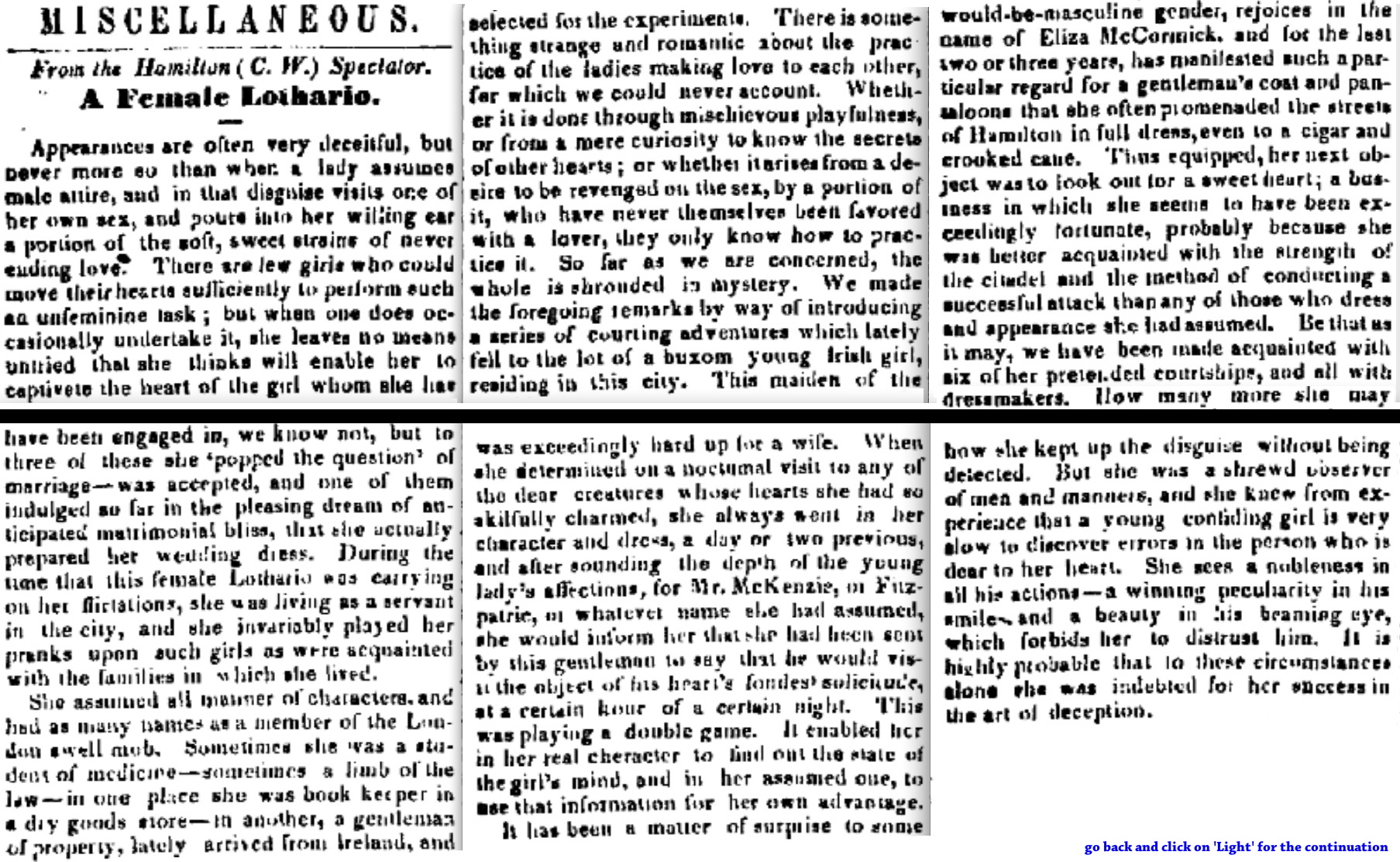
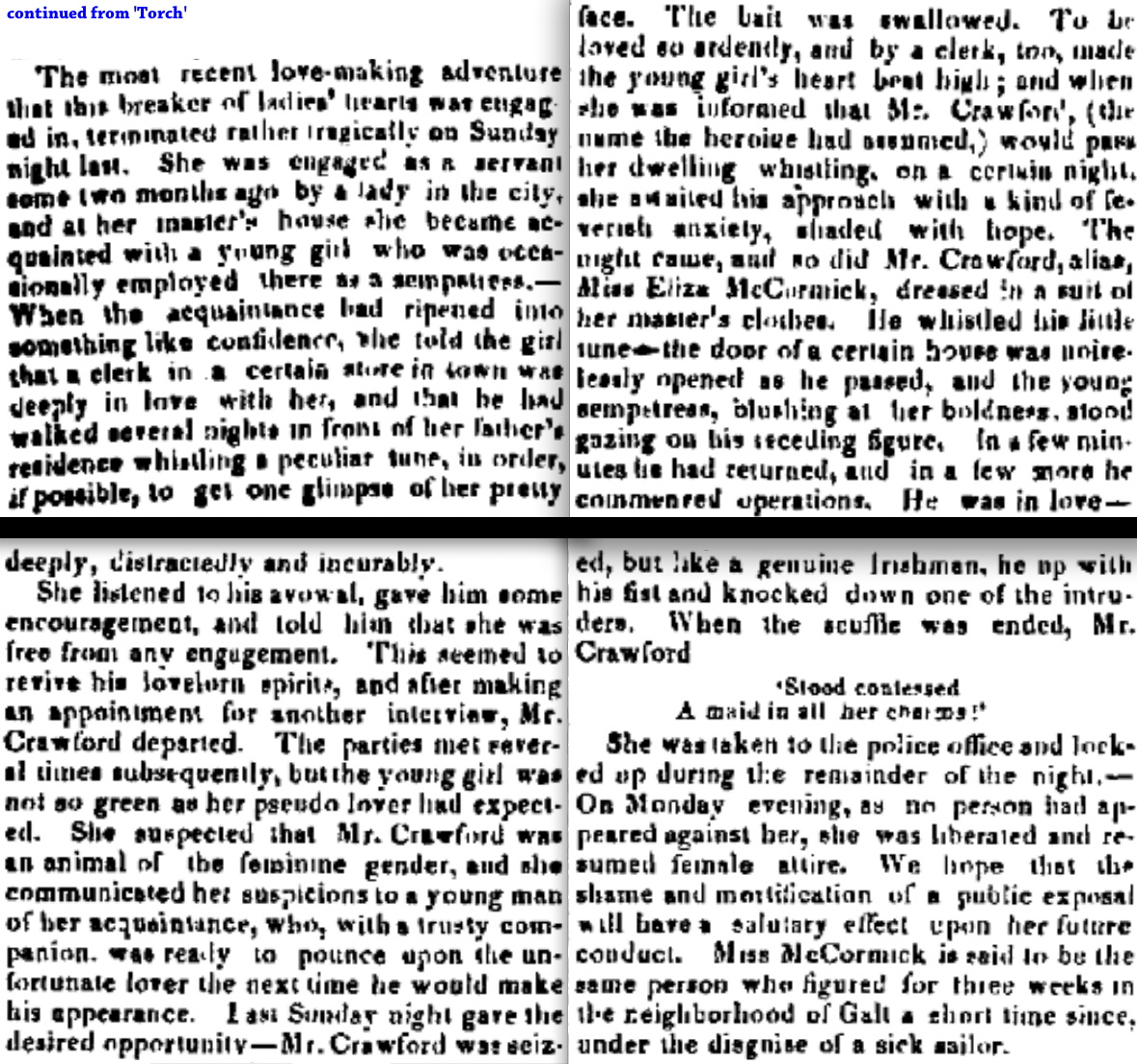
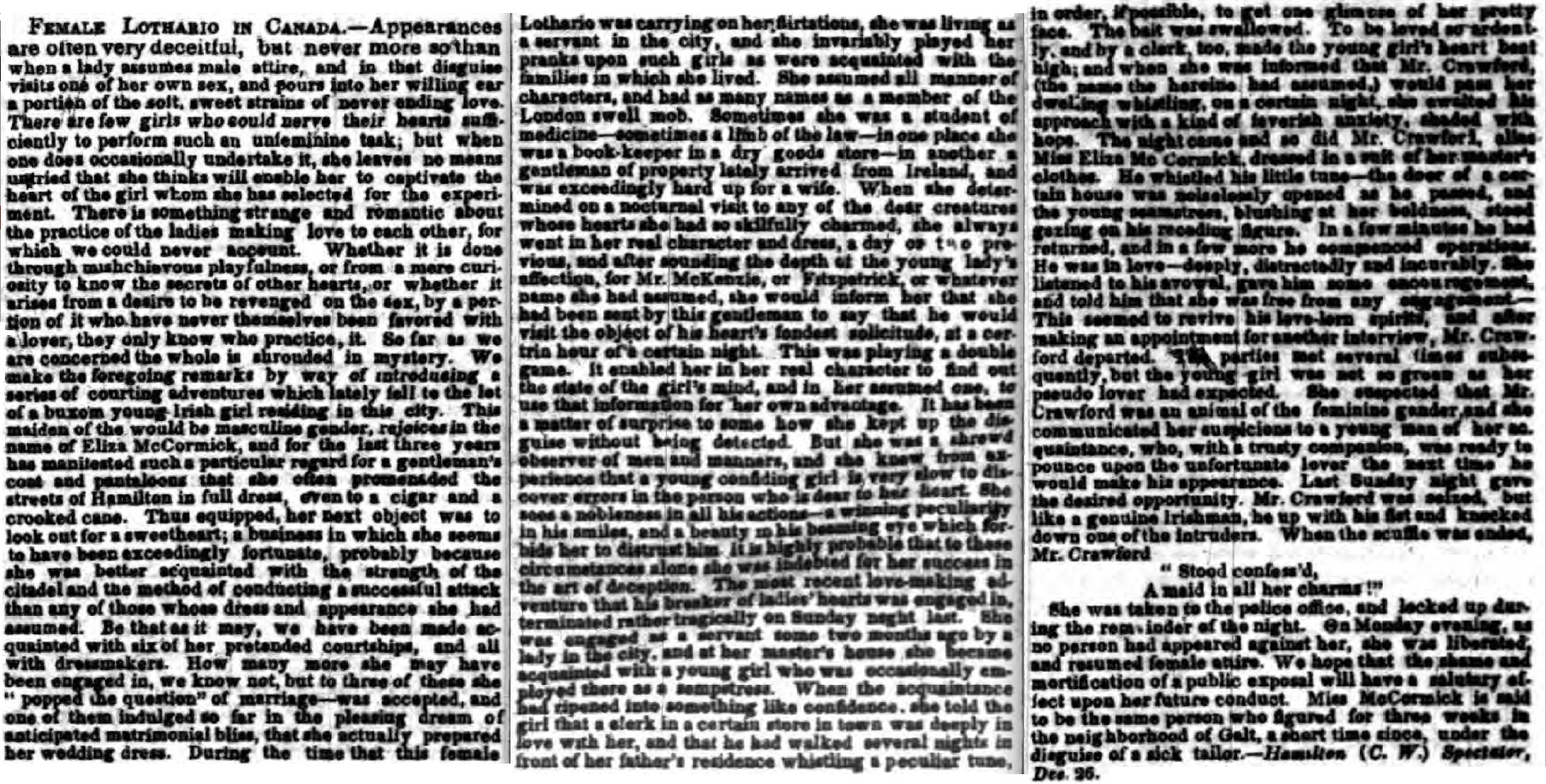
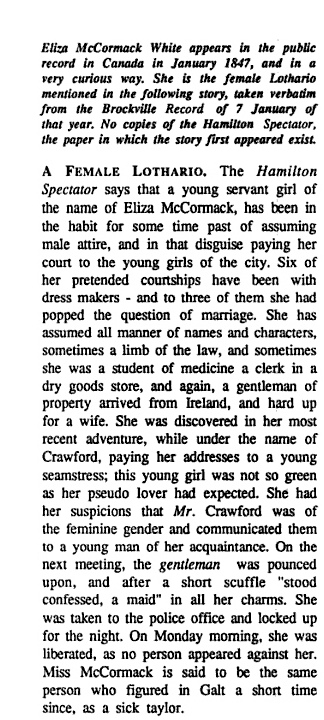
A Female Lothario.
An Irish girl named McCormick, residing in Hamilton, Canada as a servant has been guilty of a series of very strange acts. In her capacity as servant she would with a very art-address ascertain the feelings of almost every lady relative to the tender passion, telling them that Mr. —, a dry goods clerk, or a lawyer, &c. was desperately in love with them, and that he would contrive to see them on a certain night. When the night appointed came, the young gentleman would come, in the shape of Miss McCormick in male apparel. In three different cases was the question popped, and accepted; in one the wedding garment made. This fun was tried once too often, and the gay creature was locked up in jail.
Scientific American: New York, January 9, 1847.
Not surprisingly, perhaps, there are a handful of online references to this story. The original appeared in the 26 December 1846 Hamilton Spectator. In January 1847, any number of other newspapers reprinted it, including, on January 11, the Hagerstown Torch Light and the Monday morning New York Herald. Dan Akeson (who suggests that no copies of the original Hamilton Spectator story exist) published, in 1990, a book on Eliza McCormick making the outrageous claim that she transgendered herself into nineteenth-century Tory backbencher, John White.
Scientific American: New York, January 9, 1847.
Not surprisingly, perhaps, there are a handful of online references to this story. The original appeared in the 26 December 1846 Hamilton Spectator. In January 1847, any number of other newspapers reprinted it, including, on January 11, the Hagerstown Torch Light and the Monday morning New York Herald. Dan Akeson (who suggests that no copies of the original Hamilton Spectator story exist) published, in 1990, a book on Eliza McCormick making the outrageous claim that she transgendered herself into nineteenth-century Tory backbencher, John White.
Thursday, March 29, 2012
Scientific American cover art
Taking a cue from Rick and Mary Parsons' Scientific American cover art website, I decided to collate twenty-one special covers from 1896 to 1909, complementing a previously done gallery of Scientific American covers from May 1948 to August 1987.
Tuesday, March 27, 2012
$2.92
A somewhat remarkable thing happened this morning. I went to the nearby variety store (which I rarely do) to purchase a couple of 'rolls' of peppermint Certs (in preparation for tomorrow morning's dentist visit). I don't get a lot of opportunities to get rid of change so I already had a rough idea of how much I had in my wallet prior to the vendor telling me that it was going to cost me $2.92: Just a little more than I had hoped. Should I pull out a five? I wondered, but I kept on counting: one loonie, seven quarters, one dime, one nickel, and two pennies. It was the exact amount of change that I had!
Female Appellation.
When Eve brought woe to all mankind
Then Adam called her wo-man ;
But when she woo’d with love so kind
He then pronounced her woo-man.
But now with folly and with pride
Their husband’s pockets trimming,
The ladies are so full of whims
That people call them whim-men.
Scientific American: New York, December 19, 1846.
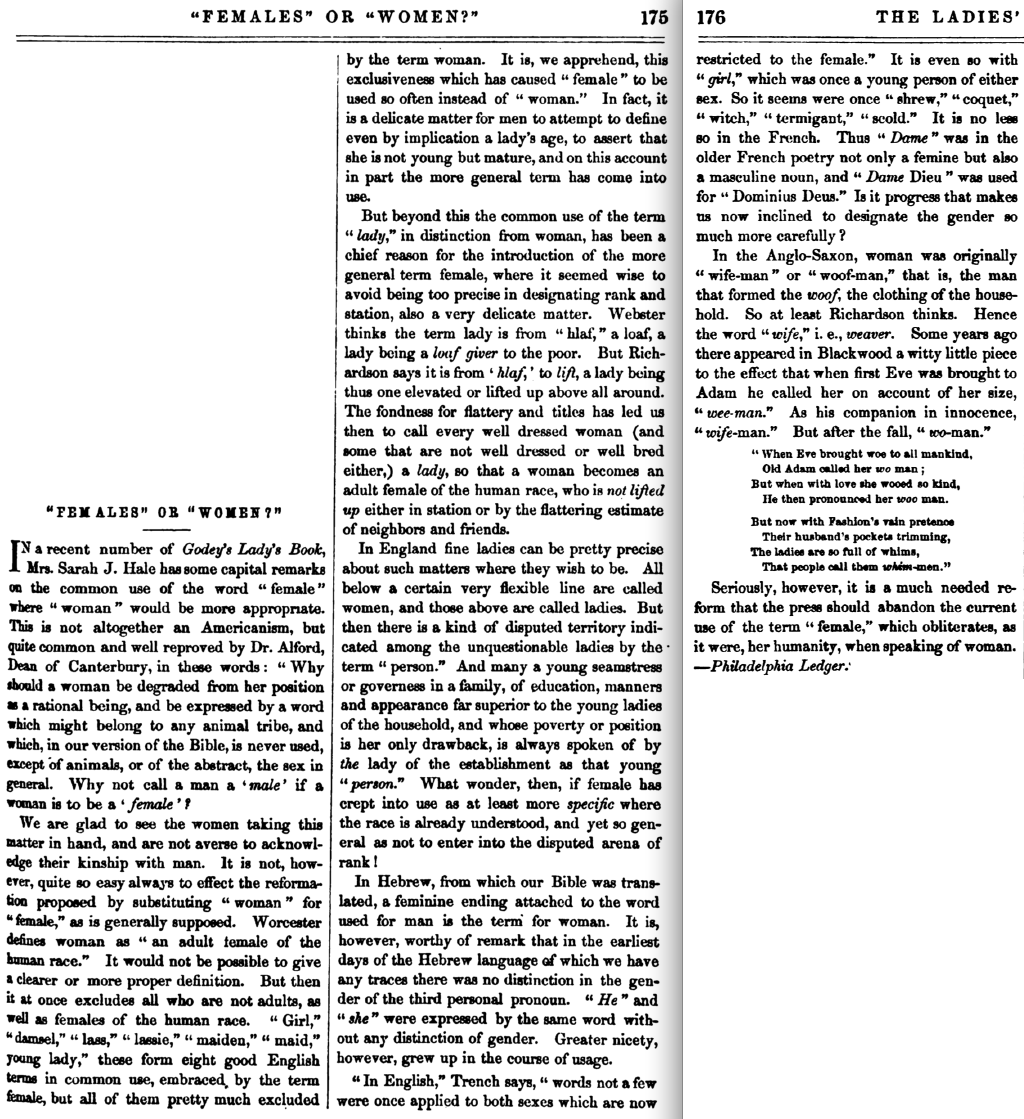
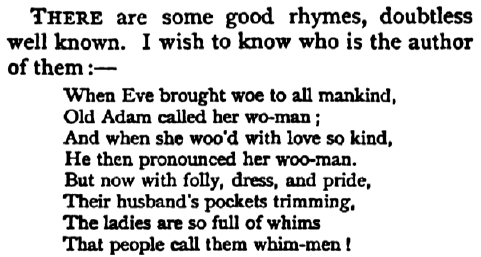
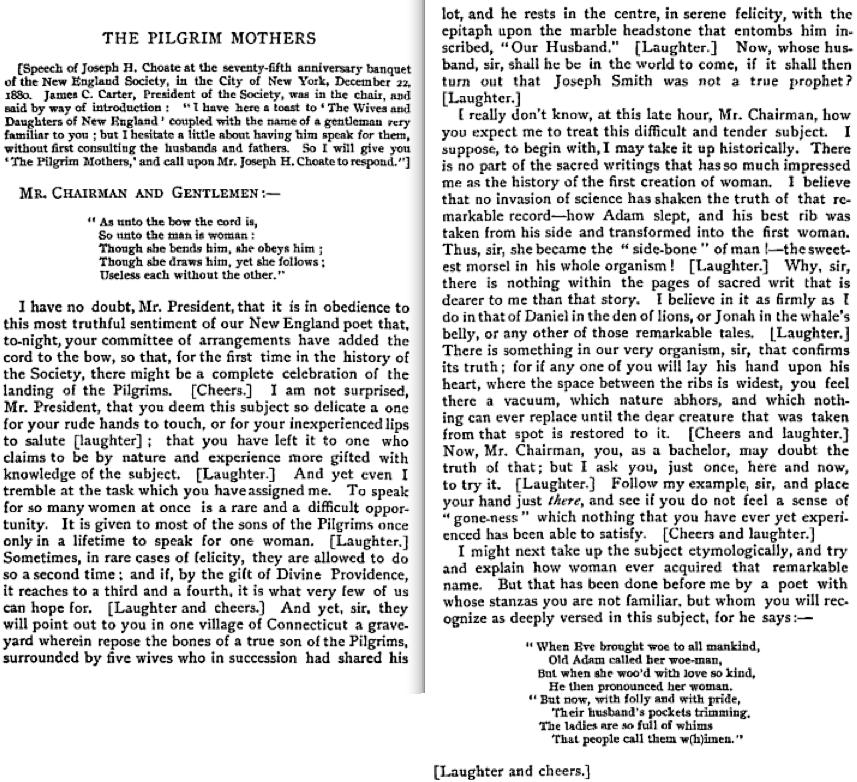
The Ladies' Repository has it in their September 1865 issue (on p.176). The 22 February 1868 Once A Week (also p.176) wonders who the author was. Joseph Hodges Choate used it in his 22 December 1880 speech (The Pilgrim Mothers), which may have helped propel it into the next century.
Then Adam called her wo-man ;
But when she woo’d with love so kind
He then pronounced her woo-man.
But now with folly and with pride
Their husband’s pockets trimming,
The ladies are so full of whims
That people call them whim-men.
Scientific American: New York, December 19, 1846.
The Ladies' Repository has it in their September 1865 issue (on p.176). The 22 February 1868 Once A Week (also p.176) wonders who the author was. Joseph Hodges Choate used it in his 22 December 1880 speech (The Pilgrim Mothers), which may have helped propel it into the next century.
We have a winner
I wrote my first blog entry here on 31 December 2010. On 18 January 2011, I wondered how long it would take to get my first comment. That comment came today! Total elapsed time: 451 days, 13 hours, 50 minutes.
Grammatical Tautology.
I’ll prove the word that I’ve made my theme,
Is that that may be doubled without blame ;
And that that that, thus trebled, I may use,
And that that THAT that critics may abuse,
May be correct. Farther—the dons to bother—
Five THATs may closely follow one another !
For be it known that we may safely write
Or say, that that THAT that that man wrote was right :
Nay, e’en, that that THAT that THAT that followed ;
And that that THAT (that that THAT that began)
Repeated seven times is right !—Deny’t who can.
Scientific American: New York, November 28, 1846.
cf. That.
Subscribe to:
Posts (Atom)