Saturday, December 31, 2011

Wednesday, December 28, 2011
The one-billionth Kaprekar number
When I published the first 11 million Kaprekar numbers on September 1, I asked what the one-billionth Kaprekar number was. Today I fashioned my answer. This was a troublesome compute that included a six-week run calculating nothing: I had used in my program the old Mathematica NthSubset directive but had neglected to first load the Combinatorica package in which it resides. Ouch!
Sunday, December 25, 2011
Digit pick-up
Consider the multiplication table for the number 125. For each product, we will pick up any digits thereof we have not already collected and add them to a growing list. When will we have collected all ten digits?
1 125 +1 +2 +5 => {1,2,5}
2 250 +0 => {0,1,2,5}
3 375 +3 +7 => {0,1,2,3,5,7}
4 500
5 625 +6 => {0,1,2,3,5,6,7}
6 750
7 875 +8 => {0,1,2,3,5,6,7,8}
8 1000
9 1125
10 1250
11 1375
12 1500
13 1625
14 1750
15 1875
16 2000
17 2125
18 2250
19 2375
20 2500
21 2625
22 2750
23 2875
24 3000
25 3125
26 3250
27 3375
28 3500
29 3625
30 3750
31 3875
32 4000 +4 => {0,1,2,3,4,5,6,7,8}
33 4125
34 4250
35 4375
36 4500
37 4625
38 4750
39 4875
40 5000
41 5125
42 5250
43 5375
44 5500
45 5625
46 5750
47 5875
48 6000
49 6125
50 6250
51 6375
52 6500
53 6625
54 6750
55 6875
56 7000
57 7125
58 7250
59 7375
60 7500
61 7625
62 7750
63 7875
64 8000
65 8125
66 8250
67 8375
68 8500
69 8625
70 8750
71 8875
72 9000 +9 => {0,1,2,3,4,5,6,7,8,9}
So, it takes 72 multiplications before we've bagged all ten digits. In base ten, it turns out that 72 is the largest number of multiplications required for any given starting number.
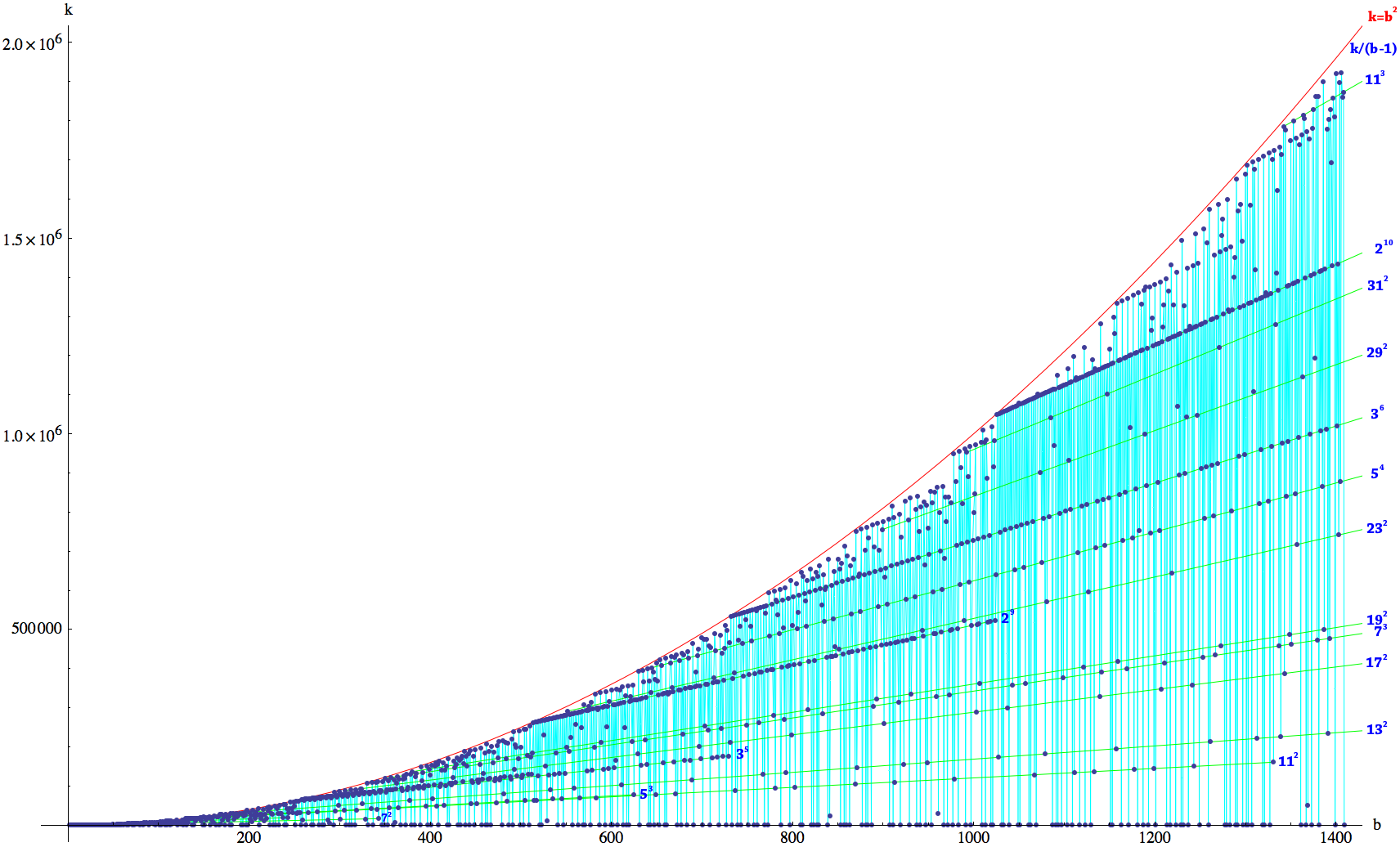
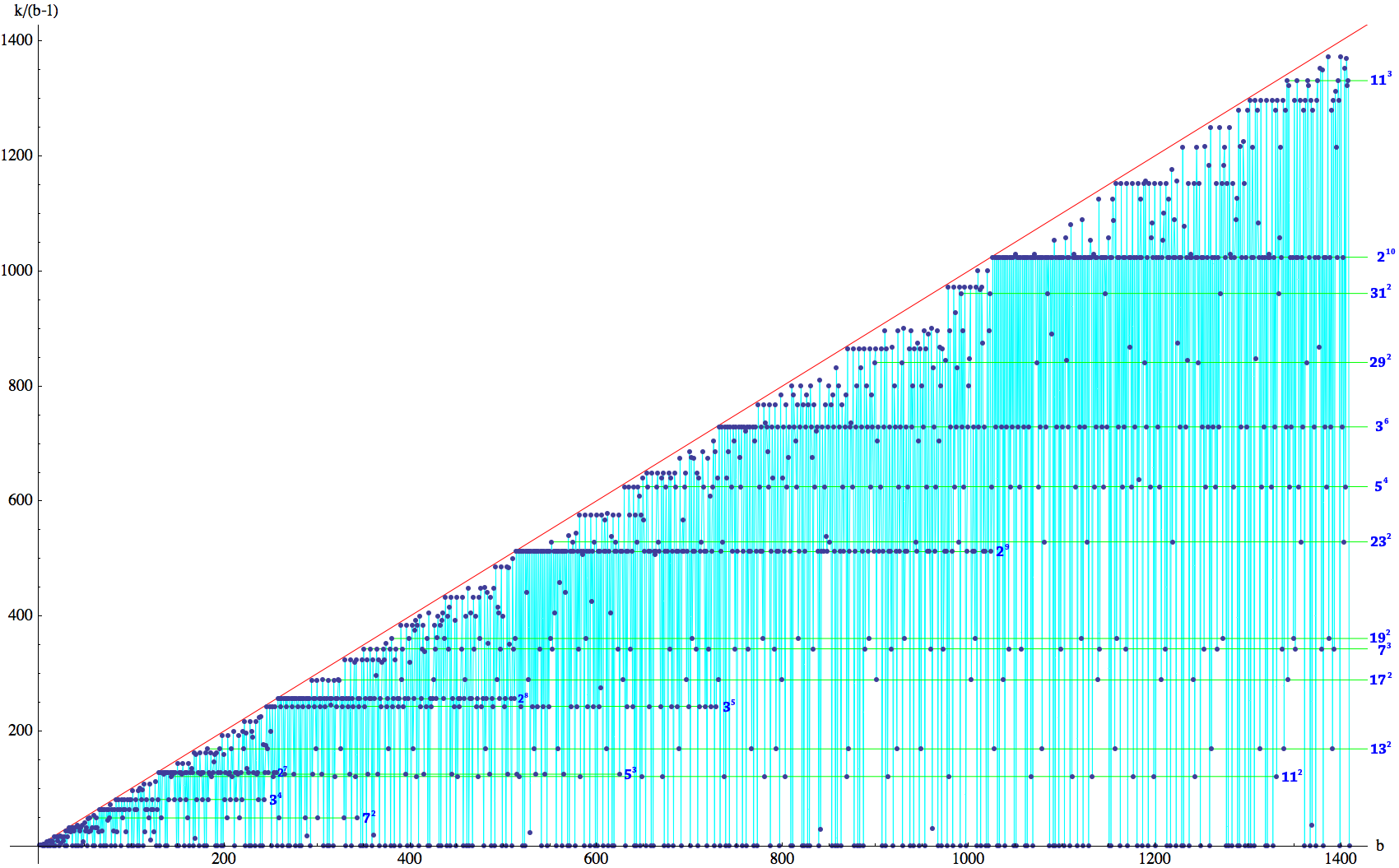
What is the largest number of multiplications required in base b? Tomas Rokicki has worked them out for thousands of bases: It's the second number on each line in his list. I felt that these maxima (k) deserved to be graphed. Noting that in composite bases k is divisible by (b-1), I decided to do another graph of k/(b-1). Then, to explicitly list the k/(b-1) straight-line points, I did the families, with a question at the end.
Sunday, November 13, 2011
Meloe yellow

Oops. Just over four minutes after taking a picture of an oil beetle at my usual spot above the river, I accidently stepped on it. At the time I thought that the exuded bright-yellow mass was liquid, but an examination of the photo revealed it to be eggs. Also visible in the image is the cantharidin-containing ochre (generally described as 'yellow') fluid exuding from the joints (detail above). Samuel Maunder's 1848 description of Meloe is here and a more modern treatment, here. I noticed my first oil beetle in the local, private cemetery three years ago. A large grassy section of this cemetery sports an extensive covering of ground-bee dwellings and the beetles have taken full advantage, being this fall every bit as bountiful as were the bees in the spring.
Wednesday, November 09, 2011
Scientific American, weakly
BoingBoing alerted me, last Friday, to the free accessing (this month only) of Scientific American weeklies from 28 August 1845 to 25 December 1909. A weeks-between lookup gives 3357 potential issues, but I think eight of those did not see publication. Of the remaining 3349 (that's four more than claimed by Scientific American), I managed to find 3246 complete, readable issues at the site, some hidden behind missing or misdirecting links.
I have been an aficionado (and eventual collector) of the magazine since discovering this issue near the end of 1967. Having a substantial, freely accessible pdf-archive of the old weeklies was, for me, a little like finding money on the street. I spent all day Saturday downloading, as a result of which I woke up Sunday morning with a debilitating lower-back issue (it became extremely painful to maintain an upright position) from which I did not recover until yesterday! I spent all of last night (until about 4:30 this morning, more carefully minding my posture) completing the heist.
I have been an aficionado (and eventual collector) of the magazine since discovering this issue near the end of 1967. Having a substantial, freely accessible pdf-archive of the old weeklies was, for me, a little like finding money on the street. I spent all day Saturday downloading, as a result of which I woke up Sunday morning with a debilitating lower-back issue (it became extremely painful to maintain an upright position) from which I did not recover until yesterday! I spent all of last night (until about 4:30 this morning, more carefully minding my posture) completing the heist.
Wednesday, October 26, 2011
Felix Aloysius Sullivan
Some three years ago I mentioned in my old blog, Felix, a relative of my wife. Today, I received a surprise email from a David Wilhelm about his relative, Kaiser Wilhelm. Wanting to share with David information about Felix, I did a search looking for my blog mention... and found instead this wonderful, previously unknown short biography!
Wednesday, October 12, 2011
Zillions
In response to the perhaps-little-known fact that the last prime in alphabetical order is two vigintillion, two undecillion, two trillion, two thousand, two hundred, ninety-three [Donald E. Knuth, Allan A. Miller: A Programming and Problem-Solving Seminar, page 12 (page 20 of the ftp-available pdf), June 1981 (the solution dating to October 1980)], I recently provided MathFun (28 September 2011) with:
____________________________________________________________
Bill Gosper:
"Yeah, what about 2*10^4679+3, (two zillion and three)-?"
Phil Carmody:
"It seems to precede 2*10^4772+2003 (two zillion two thousand and three)"
It's instructive here to look at the original (without using 'zillion') answer: 2*10^63 + 2*10^36 + 2*10^12 + 2*10^3 + 2*10^2 + 93 (two vigintillion, two undecillion, two trillion, two thousand, two hundred, ninety, three). The 93 is forced because it is the only two-digit number that will make the entire quantity prime, but 23 (twenty, three) would have been a more desirable choice to force the written number to the back of the dictionary. Just 2 (two) would have been even better but a number ending in 2 cannot be prime.
So, let's prepend the 'two zillion' (2*10^n) and force the presumably-optimal 23 ending.
2*10^n (two zillion)
+2*10^63 (two vigintillion)
+2*10^36 (two undecillion)
+2*10^12 (two trillion)
+2000 (two thousand)
+200 (two hundred)
+20 (twenty)
+3 (three)
Of course, n >=66 because we have perfectly good, widely-dictionaried names for numbers less than this. A quick run has n = {77, 113, 116, 158, 342, 464, 468, 565, 2171, 2274, 2340, 3347, 5724, ...}. That might have been the end of it, but I noticed that there is nothing to prevent our indefinite 'zillion' from being repeated. And every repetition forces the written number further back in the dictionary. So one begins to look at the divisors of n to see which combination results in the most number of greater-than-10^66 (zillion) amounts. For example, 10^5724 = 10^1431 * 10^1431 * 10^1431 * 10^1431, so, taking a zillion to be 10^1431, our large prime starts out with "two zillion zillion zillion zillion, two vigintillion, ..." Our n = 2340 solution allows for 30 written zillions (of 10^78 each).
____________________________________________________________
____________________________________________________________
Bill Gosper:
"Yeah, what about 2*10^4679+3, (two zillion and three)-?"
Phil Carmody:
"It seems to precede 2*10^4772+2003 (two zillion two thousand and three)"
It's instructive here to look at the original (without using 'zillion') answer: 2*10^63 + 2*10^36 + 2*10^12 + 2*10^3 + 2*10^2 + 93 (two vigintillion, two undecillion, two trillion, two thousand, two hundred, ninety, three). The 93 is forced because it is the only two-digit number that will make the entire quantity prime, but 23 (twenty, three) would have been a more desirable choice to force the written number to the back of the dictionary. Just 2 (two) would have been even better but a number ending in 2 cannot be prime.
So, let's prepend the 'two zillion' (2*10^n) and force the presumably-optimal 23 ending.
2*10^n (two zillion)
+2*10^63 (two vigintillion)
+2*10^36 (two undecillion)
+2*10^12 (two trillion)
+2000 (two thousand)
+200 (two hundred)
+20 (twenty)
+3 (three)
Of course, n >=66 because we have perfectly good, widely-dictionaried names for numbers less than this. A quick run has n = {77, 113, 116, 158, 342, 464, 468, 565, 2171, 2274, 2340, 3347, 5724, ...}. That might have been the end of it, but I noticed that there is nothing to prevent our indefinite 'zillion' from being repeated. And every repetition forces the written number further back in the dictionary. So one begins to look at the divisors of n to see which combination results in the most number of greater-than-10^66 (zillion) amounts. For example, 10^5724 = 10^1431 * 10^1431 * 10^1431 * 10^1431, so, taking a zillion to be 10^1431, our large prime starts out with "two zillion zillion zillion zillion, two vigintillion, ..." Our n = 2340 solution allows for 30 written zillions (of 10^78 each).
____________________________________________________________
The term after n = 5724 is n = 39960. The resulting 39961-digit probable prime is now on Henri & Renaud Lifchitz's Probable Prime Records site.
Thursday, September 01, 2011
The first 11 million Kaprekar numbers
Just published. I won't know the answer to the appended question anytime soon.
Wednesday, August 31, 2011
Spoonful
David 'Honeyboy' Edwards died on Monday, so yesterday I listened to a bit of what I had of his in iTunes (mostly the Delta Bluesman album). One of the songs was Just a Spoonful, which brought me to list all of the 'Spoonful' covers that I had: about a dozen. Cream's short six-and-a-half-minute version from Fresh Cream played next and I was reminded that they had a long version on their Wheels of Fire double-album which, back in the day, I once owned. But the album was missing from my iTunes library, so I downloaded it — and am listening to it today. Catherine actually brought into our relationship the Fresh Cream album (along with The Incredible String Band's Wee Tam & The Big Huge), acquired back then from Kay Owen, her British cousin. Much appreciated music, even after all these years.
Tuesday, August 16, 2011
The largest base-24 left-truncatable prime
10594160686143126162708955915379656211582267119948391137176997290182218433
As previously aspired to, I have now replicated Martin Fuller's 2008 determination of all base-24 left-truncatable primes. I don't know if Martin thought to store the largest of these as part of his program, but I don't see it anywhere on the Net and more specifically not in the a-file for A103443, where it belongs. It's the 53-digit number {17, 22, 19, 14, 19, 15, 10, 3, 10, 7, 1, 13, 18, 13, 9, 22, 15, 22, 23, 15, 14, 3, 13, 3, 20, 19, 17, 10, 6, 1, 20, 17, 9, 2, 18, 15, 12, 10, 3, 21, 11, 8, 16, 15, 4, 4, 4, 15, 11, 11, 7, 10, 17}.
As previously aspired to, I have now replicated Martin Fuller's 2008 determination of all base-24 left-truncatable primes. I don't know if Martin thought to store the largest of these as part of his program, but I don't see it anywhere on the Net and more specifically not in the a-file for A103443, where it belongs. It's the 53-digit number {17, 22, 19, 14, 19, 15, 10, 3, 10, 7, 1, 13, 18, 13, 9, 22, 15, 22, 23, 15, 14, 3, 13, 3, 20, 19, 17, 10, 6, 1, 20, 17, 9, 2, 18, 15, 12, 10, 3, 21, 11, 8, 16, 15, 4, 4, 4, 15, 11, 11, 7, 10, 17}.
Subscribe to:
Posts (Atom)