Saturday, December 31, 2016

Monday, December 26, 2016
Lateral thinking
Today's Futility Closet features lateral thinking — which folk of my generation associate with Edward de Bono's 1967 "The Use of Lateral Thinking". Wikipedia suggested that de Bono had coined the expression. After a quick check with Google Books, I decided to replace "coined" with "promulgated" but, alas, most of my earlier-than-1967 references turned out to be later ones — a hazard of Google Books' date-assignment methodology.
Fortunately, I did find one that did not so evaporate. It is from Edward T. Owen's article "Linguistic Aberrations" in the "Transactions of the Wisconsin Academy of Sciences, Arts, and Letters" (volume XXIII, 1927, page 434):
Fortunately, I did find one that did not so evaporate. It is from Edward T. Owen's article "Linguistic Aberrations" in the "Transactions of the Wisconsin Academy of Sciences, Arts, and Letters" (volume XXIII, 1927, page 434):
In matters mental, for convenience, let it be supposed that we have reached our limit with e. g. the idea-plexus indicated by the woman and her prepossessing qualities. Our words for these we shall marshal as we please, for the ideas of each of us are simultaneous. The like is true of the husband and his qualities. And even when I say "There is a handsome _ _ _ _ woman with an ugly _ _ _ _ husband", I exhibit what might also be regarded as a single mental picture, since it is continuous. Its continuity is however that of the old fashioned panorama. Its constituent pictures come upon the mental stage successively. No doubt, indeed, while thinking of the woman I am also conscious of the man to come. The mind is somewhat like the eye; even the momentary scope of either is considerable. While intently looking at you I take note of the surrounding objects. While I add my bank deposits, I am wondering if the total will be big enough to pay my bills. The eye does much by lateral vision and the mind by lateral thinking.* But such seeing and such thinking are both vague. My lateral thinking of the man to come is not presumably distinct enough e. g. to meet the needs of word-selection.
________
* I do not intend by "lateral" that only which is figuratively conceivable as to the right or left. I have no faith in mental limitations thus suggested. Were the word "eccentric" not preempted, it would serve my purpose of suggesting what is in the mind but is not central — whether to the right or left, above, below or even too near, too far — say out of focus — I care little.
Friday, December 09, 2016
Earthquakes
The U.S. Geological Survey has a latest earthquakes website that you can configure (and then, bookmark) by clicking on the white gear icon (top right) for options and settings. From the defaults I change the Earthquakes to 1 Day, All Magnitudes Worldwide, the Map Layers to Terrain, and the Time Zone to Local System Time. You can then click on the now-cyan gear icon to dismiss the right settings panel. Likewise, you can click on the cyan list icon to dismiss the left list panel. That leaves you with a cyan globe icon and a default map of the United States. You can now zoom out (or in) by using the plus/minus signs at the top left (or by using your scroll wheel). I get it to some manner of world-view that fits my particular browser window size and this I bookmark.
When a large earthquake hits, I scroll wheel over the place to zoom into it and often leave the browser tab there for a few days to watch the aftershocks develop. The following is a screen grab of the current situation based on yesterday's 7.8 Solomon Islands quake. With Auto Update on, new aftershocks will appear and stay red for an hour.

I love the detail in the zoomed-in maps. I'm intrigued by the fact that (in the above map of Makira) four of the islands to its north have an identical high point of 91 m (above sea level).
When a large earthquake hits, I scroll wheel over the place to zoom into it and often leave the browser tab there for a few days to watch the aftershocks develop. The following is a screen grab of the current situation based on yesterday's 7.8 Solomon Islands quake. With Auto Update on, new aftershocks will appear and stay red for an hour.

I love the detail in the zoomed-in maps. I'm intrigued by the fact that (in the above map of Makira) four of the islands to its north have an identical high point of 91 m (above sea level).
Friday, December 02, 2016
As it happens

When you hear/see a helicopter hovering overhead here in Toronto, it's an indication of a nearby news story.

Friday, November 25, 2016
A deep walk in base-two pi
After I managed to calculate 8 billion ternary digits of π, I figured that I could probably generate 10 billion binary digits thereof. My previous effort was 1 billion binary digits. I won't bother graphing the walk but I will report that my output of the indices of zero therein has jumped from 45915 to 147043.
Addendum: I've stepped through those 10 billion digits a couple more times. In the walk, I counted 5738590822 terms that are positive and 4261262135 terms that are negative. I've also checked record maxima and minima and submitted them as two new sequences: A278737 and A278738.
Addendum: I've stepped through those 10 billion digits a couple more times. In the walk, I counted 5738590822 terms that are positive and 4261262135 terms that are negative. I've also checked record maxima and minima and submitted them as two new sequences: A278737 and A278738.
A deep walk in base-three pi
In my previous post I set up a graphical depiction of the ternary digits of π by "walking" them from the origin to (950,2678) in 25 million steps. Here is an alternate view — in orange — of the same walk (click on the picture to better see the detail):


This is a compressed version of my previous graph as only one of every one thousand points is shown and connected. I have added an x=y line to indicate where along the walk the accumulated number of ones and twos might be equal. (950,2678) is shown as a black dot. Starting at that point — in cyan — I have continued the walk (a bit of the left and a lot of the right of it has been cropped). The full walk to 8 billion looks like this:

A hint of orange near the origin betrays the change in scale of the continuation. After step 8 billion we have reached (42488,102078), also marked by a black dot. Which is to say that we have a digit deficit at this point of 102078 zeros and 59590 twos! I counted 96619 times that the number of ones and twos were exactly equal. And we are left with 0, 15, and 18 initial ternary-π digits as the only known instances where the number of all three digits are exactly equal.
Addendum: I have upped the walk from 8 billion steps to 10 billion steps, where we have reached (35427,93367).
Wednesday, November 16, 2016
A walk in base-three pi
Looking at the output of my previous post, it would be natural to believe that A039624 is infinite. What about a base-three analogue? For how many of the initial digits in the ternary representation of π are there solutions where the number of zeros, ones, and twos are all exactly equal? In base three, π = 10.010211012222010211... After a preliminary no-digits, the first 15 and 18 digits also clearly qualify. Then what?
I wanted to explore this graphically, so I converted π's ternary digits to vectors in a Cartesian coordinate system. I let the digit 1 be the vector (0,1); the digit 2, (1,0); and the digit 0, (-1,-1). If we start at (0,0), every time we revisit the origin we should have an exactly equal number of zeros, ones, and twos:
1 (0,0) + (0,1) = (0,1)
2 (0,1) + (-1,-1) = (-1,0)
3 (-1,0) + (-1,-1) = (-2,-1)
4 (-2,-1) + (0,1) = (-2,0)
5 (-2,0) + (-1,-1) = (-3,-1)
6 (-3,-1) + (1,0) = (-2,-1)
7 (-2,-1) + (0,1) = (-2,0)
8 (-2,0) + (0,1) = (-2,1)
9 (-2,1) + (-1,-1) = (-3,0)
10 (-3,0) + (0,1) = (-3,1)
11 (-3,1) + (1,0) = (-2,1)
12 (-2,1) + (1,0) = (-1,1)
13 (-1,1) + (1,0) = (0,1)
14 (0,1) + (1,0) = (1,1)
15 (1,1) + (-1,-1) = (0,0)
16 (0,0) + (0,1) = (0,1)
17 (0,1) + (-1,-1) = (-1,0)
18 (-1,0) + (1,0) = (0,0)
19 (0,0) + (0,1) = (0,1)
20 (0,1) + (0,1) = (0,2)
...
And indeed, we re-arrive at the origin at steps 15 and 18. Then what?

The graph shows 25 million steps, with the initial (0,0) and final (950,2678) points shown in red. Yes, we should get back to the origin eventually but it's not as easy to believe as it is for base-two. It should be more understandable then that providing an exactly-equal number of all base-b digits in some initial terms of base-b π with b > 3 will be difficult. Regardless, we have in base-four, the first 4 digits (3.021) and in base-five, the first 75 digits!
I wanted to explore this graphically, so I converted π's ternary digits to vectors in a Cartesian coordinate system. I let the digit 1 be the vector (0,1); the digit 2, (1,0); and the digit 0, (-1,-1). If we start at (0,0), every time we revisit the origin we should have an exactly equal number of zeros, ones, and twos:
1 (0,0) + (0,1) = (0,1)
2 (0,1) + (-1,-1) = (-1,0)
3 (-1,0) + (-1,-1) = (-2,-1)
4 (-2,-1) + (0,1) = (-2,0)
5 (-2,0) + (-1,-1) = (-3,-1)
6 (-3,-1) + (1,0) = (-2,-1)
7 (-2,-1) + (0,1) = (-2,0)
8 (-2,0) + (0,1) = (-2,1)
9 (-2,1) + (-1,-1) = (-3,0)
10 (-3,0) + (0,1) = (-3,1)
11 (-3,1) + (1,0) = (-2,1)
12 (-2,1) + (1,0) = (-1,1)
13 (-1,1) + (1,0) = (0,1)
14 (0,1) + (1,0) = (1,1)
15 (1,1) + (-1,-1) = (0,0)
16 (0,0) + (0,1) = (0,1)
17 (0,1) + (-1,-1) = (-1,0)
18 (-1,0) + (1,0) = (0,0)
19 (0,0) + (0,1) = (0,1)
20 (0,1) + (0,1) = (0,2)
...
And indeed, we re-arrive at the origin at steps 15 and 18. Then what?

The graph shows 25 million steps, with the initial (0,0) and final (950,2678) points shown in red. Yes, we should get back to the origin eventually but it's not as easy to believe as it is for base-two. It should be more understandable then that providing an exactly-equal number of all base-b digits in some initial terms of base-b π with b > 3 will be difficult. Regardless, we have in base-four, the first 4 digits (3.021) and in base-five, the first 75 digits!
A walk in base-two pi
In base two, π = 11.001001000011111101101010100010001... Ignoring the decimal point and replacing every zero with minus one, we get: 1, 1, -1, -1, 1, -1, -1, 1, -1, -1, -1, -1, 1, 1, 1, 1, 1, 1, -1, 1, 1, -1, 1, -1, 1, -1, 1, -1, -1, -1, 1, -1, -1, -1, 1, ... We can now treat these numbers as a one-dimensional walk on the y-axis. Accumulating: 1, 2, 1, 0, 1, 0, -1, 0, -1, -2, -3, -4, -3, -2, -1, 0, 1, 2, 1, 2, 3, 2, 3, 2, 3, 2, 3, 2, 1, 0, 1, 0, -1, -2, -1, ... Finally, we graph this sequence:

The picture is very much compressed, showing only one of every one hundred points. What looks like a single crossing from positive to negative territory at 10^8, plotting the values from 100000000 to 101400000 details to this:


The picture is very much compressed, showing only one of every one hundred points. What looks like a single crossing from positive to negative territory at 10^8, plotting the values from 100000000 to 101400000 details to this:

Even this detail is lacking. What appear to be a couple of dozen y = 0 values are actually 2409 such, ranging from 100023378 to 101375384. The list of zeros constitute the terms of A039624 and I've just calculated 45915 of them.
Monday, November 14, 2016
Fear of height

The Humber river retaining wall is approaching its northern limit. In the photo (above), the house at the top-right is actually at the end of the street on which I live. Yesterday, I climbed to the top of the wall at its southern end — five meters above the (shallow) water. Here are two pictures taken from that vantage — looking across to the other side of the river, and towards the north:

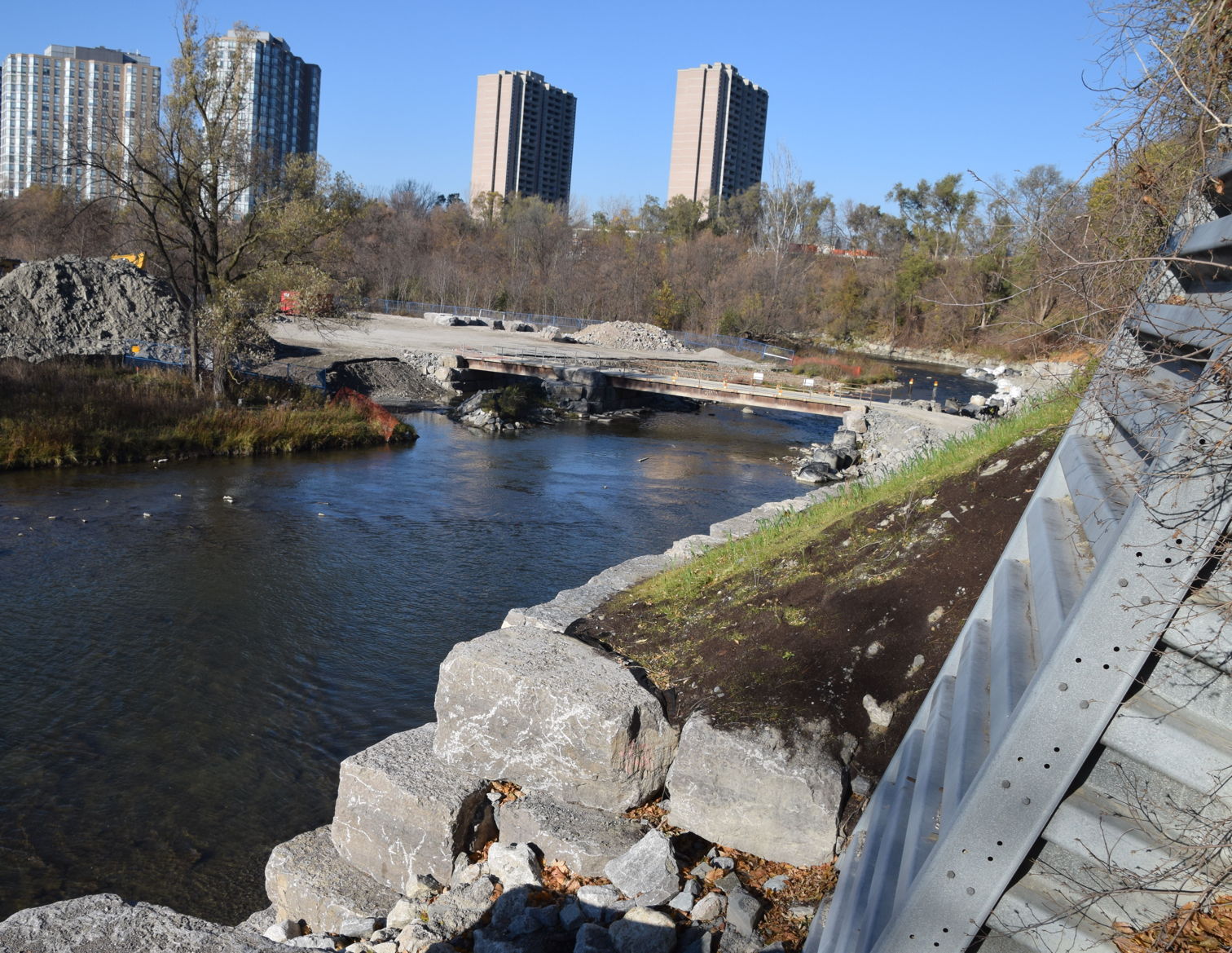
It didn't feel the least bit safe and I was glad to climb down again.
Saturday, November 05, 2016
More 3-balanced factorization integers
Four weeks ago I discovered what I now know to be the smallest base-ten 3-balanced factorization integer. By the end of October I had completed my base-ten k-balanced list to 10^12 and decided to extend the search to 1.5 * 10^12, thus including (when finished) the first of the four 13-digit 2-balanced factorization integers. I was of course also hoping for more (small) 3-balanced examples. Yesterday and today one of my processors found these (which thusly become the second-, third-, and fourth-smallest):
1045675984884 = 2^2 * 3 * 17 * 67 * 103 * 359 * 2069
1046959786860 = 2^2 * 3 * 5 * 13 * 43 * 2087 * 14957
1047697856460 = 2^2 * 3^2 * 5 * 109 * 347 * 153889
My ill-fated, eight digits reverse search is now back on track, though I realize that it will take a good while to complete. It will rediscover the twenty-one 12-digit 2-balanced factorization integers and — more excitingly — has already come up with a k-balanced solution for k > 2.
1045675984884 = 2^2 * 3 * 17 * 67 * 103 * 359 * 2069
1046959786860 = 2^2 * 3 * 5 * 13 * 43 * 2087 * 14957
1047697856460 = 2^2 * 3^2 * 5 * 109 * 347 * 153889
My ill-fated, eight digits reverse search is now back on track, though I realize that it will take a good while to complete. It will rediscover the twenty-one 12-digit 2-balanced factorization integers and — more excitingly — has already come up with a k-balanced solution for k > 2.
Subscribe to:
Posts (Atom)