Tuesday, July 09, 2013

Do without

"Why shouldn't I buy it? I've got the money!"

Sure you've got the money. So have lots of us. And yesterday it was all ours, to spend as we darn well pleased. But not today. Today it isn't ours alone.


"What do you mean, it isn't mine?"

It isn't yours to spend as you like. None of us can spend as we like today. Not if we want prices to stay down. There just aren't as many things to buy as there are dollars to spend. If we all start scrambling to buy everything in sight, prices can kite to hell-'n'-gone.

"You think I can really keep prices down?"

If you don't, who will? Uncle Sam can't do it alone. Every time you refuse to buy something you don't need, every time you refuse to pay more than the ceiling price, every time you shun a black market, you're helping to keep prices down.

"But I thought the government put a ceiling on prices."

You're right, a price ceiling for your protection. And it's up to you to pay no more than the ceiling price. If you do, you're party to a black market deal. And black markets not only boost prices — they cause shortages.

"Doesn't rationing take care of shortages?"

Your ration coupons will — if you use them wisely. Don't spend them unless you have to. Your ration book merely sets a limit on your purchases. Every coupon you don't use today means that much more for you — and everybody else — to share tomorrow.

"Then what do you want me to do with my money?"

Save it! Put it in the bank! Put it in life insurance! Pay off old debts and don't make new ones. Buy and hold War Bonds. Then your money can't force prices up. But it can speed the winning of the war. It can build a prosperous nation for you, your children, and our soldiers, who deserve a stable America to come home to. Keep your dollars out of circulation and they'll keep prices down. The government is helping — with taxes.

"Now wait! How do taxes help keep prices down?"

We've got to pay for this war sooner or later. It's easier and cheaper to pay as we go. And it's better to pay more taxes NOW — while we've got the extra money to do it. Every dollar put into taxes means a dollar less to boost prices. So...

Use it up ... Wear it out ... Make it do ... Or do without

[This advertising appeared in a number of U.S. magazines in early 1944.]

Sunday, June 09, 2013

Lore of the (complicated) rings


A puzzle such as the one illustrated was mentioned by Italian mathematician Luca Pacioli in his De Viribus Quantitatis (1496-1508). (I should point out that the caption underneath the illustrated text at this site belongs underneath the rings picture to its right.) Not long after Pacioli's mention, there is an apparent reference to it by Yang Shen (1488-1559): "Nowadays, we also have an object called nine linked rings. It’s made of brass or iron instead of jade. It’s a toy for women and children." The quotation is taken from this page. There have been attempts to place the puzzle in China even earlier: The oft-repeated story that it was invented by Hung Ming (181-234) belongs to Stewart Culin's Korean Games (1895) and is clearly not a serious possibility. Another suggestion that it was known in the Sung Dynasty (960-1279) belongs, I think, to Ch’ung‑En Yü's Chinese Ingenious Ring Puzzle Book (1958) or, more properly, to Yenna Wu's 1981 translation of it (neither of which I have seen), although V. Frederick Rickey suggests (perhaps erroneously) in this 2005 paper that it is from Stewart Culin. My take is that the Sung Dynasty connection is not, at present, credible.

Another European mention of the puzzle rings comes from Gerolamo Cardano's Latin De Subtilitate (~1550). John Wallis gives us a thorough description and illustration of the 'complicated rings', as well as its solution, in his Latin Algebra (1693). We find another picture of the rings in Jacques Ozanam's Récréations Mathématiques et Physiques (~1723). Hung Lou Meng's The Dream of the Red Chamber (~1750) mentions the "nine strung rings" puzzle (in H. Bencraft Joly's 1891 translation). From Johann Nikolaus Martius, by way of Johann Christian Wiegleb, we have Unterricht in der natürlichen Magie (1789), where it is chaptered Die Zauberkette oder das magische Ringspiel, complete with solution. Zhu Xiang Zhuren's Little Wisdoms appeared ~1821. Concurrently, William Clarke's treatment in The Boy's Own Book (1828) is shown here in an 1849 edition. He mentions the puzzle being called The Tiring Irons. The article was reprinted without provenance in The Magician's Own Book (1857), which is identical to The Book of 500 Curious Puzzles (1859).

A significant treatment of the puzzle arrived with a pamphlet written by Louis Agathon Gros: Théorie du Baguenodier (1872). David Singmaster was looking for this many years ago and I have not been able to find a copy either! Andreas M. Hinz, Sandi Klavžar, Uroš Milutinović, and Ciril Petr have recently named OEIS sequence A001511 the Gros sequence for this pamphlet's contribution.

A flurry of renewed interest rounds out the 1800s: The puzzle is in T. (which stands for what?) de Moulidars' Grande Encyclopédie des Jeux (1888), Le baguenaudier; Édouard Lucas' Récréations Mathématiques (1891), Le Jeu du Baguenaudier; W.W. Rouse Ball's Mathematical Recreations (1892), Chinese Rings; and Professor Hoffmann's Puzzles Old and New (1893), Cardan's Rings. Lucas footnotes (via O.-J. Broch) that in Norway the puzzle was used as a lock, a subsequently much-touted fiction. Rouse Ball (according to Singmaster) already noted that "It is said — though a priori the fact would have seemed very improbable — that Chinese rings are used in Norway to fasten the lids of boxes, ... I have never seen them employed for such purposes in any part of the country in which I have travelled." The objection, alas, was dropped from the third edition of Mathematical Recreations. Rouse Ball may have been the first to reference Cardan as paragraph 2 of Book 15, but I wonder if he was ignoring (or labeling as paragraph zero) the start of the De Subtilitate page (look for "Hoc instrumento ludus excogitatus mirae subtilitatis" near the bottom). Hoffmann talks of "the puzzling rings" and "the tiring irons" but makes 'Baguenaudier' feminine. He credits his solution to "an anonymous American writer" but it is clearly that of Clarke's Boys Own. Furthermore, his reference to another explanation in the Encyclopédie Méthodique des Jeux is likely meant to refer to that of Moulidars' Grande Encyclopédie.

Henry Ernest Dudeney has the puzzle as The Tiring Irons in Amusements in Mathematics (1917). Singmaster has noted that "the OED entry at Tiring-irons gives 5 quotations from the 17C: 1601, 1627, 1661, 1675, 1690." He also notes the variants Tyring or Tarrying Irons, and Tarriours. From Culin (1895) we have "Ryou-kaik-tjyo (Chinese, lau kák ch’á), or 'Delay guest instrument', is the name given to the familiar ring and bar puzzle which the Chinese call kau tsz' lin wán, or 'nine connected rings'." Pieter van Delft and Jack Botermans call it meleda in Creative Puzzles of the World (1978). More specifically: "Meleda first appeared in Europe in the mid-16th century and was described by the Italian mathematician Geronimo Cardano." Some readers of this sentence seem to have misinterpreted it to mean that the word goes back to Cardan. In fact, the introduction of meleda into English (it appears already in the puzzle sense in an 1835 Russian-French dictionary) is likely connected to the 1963 Halina Moss translation of Aleksandr Petrovich Domoryad's 1961 Russian Mathematical Games and Pastimes. In Puzzles Old & New (1986), Jerry Slocum and Jack Botermans go back to calling the puzzle Chinese Rings and otherwise repeat a lot of questionable gossip (the "Seal of Salomon" almost certainly refers to a different puzzle).

Martin Gardner's August 1972 column in Scientific American, The curious properties of the Gray code and how it can be used to solve puzzles, mentioned the Chinese rings. The article received a significant addendum in its reprinting as The Binary Gray Code in Knotted Doughnuts (1986) which mentions Sydney N. Afriat's The Ring of Linked Rings (1982), a book I have yet to read. Gardner suggested: "The Japanese became so intrigued by the puzzle in the 17th century that they wrote Haiku poems about it, and symbols of the linked rings appeared on heraldic emblems." These assertions beg for verification. Gardner also quotes the Oxford English Dictionary for this 1782 doggerel:

Have you not known a small machine
Which brazen rings environ,
In many a country chimney seen
Y-clep’d a tarring-iron?

There is a more complete version (transcript) attributed to S.S. (attributable to William Shenstone) in The Gentleman's Magazine Volume X (October 1740). The mention of the puzzle in chimneys is surely a bit of a mystery. Dudeney (1917) said that "it is said still to be found in obscure English villages (sometimes deposited in strange places, such as a church belfry)." What's up with that?

Sunday, May 19, 2013

A Canadian propensity for environmental hyperbole

I was more than a little confused when the (magnitude 4.4) May 17 Shawville earthquake was persistently described by the media as being magnitude 5.2. Canadians are totally insecure about their place in the world so, when it comes to reporting the environment, bigger is better. Of course this also makes for attention-getting headlines.

We know this to be the case for television weather-reporting, where summer temperatures are made to appear warmer through use of a humidity index, and winter temperatures made colder by using a wind-chill index.

It turns out that Canadians do something similar for certain earthquakes by using a Nuttli magnitude index. Apparently, "Canadian seismologists will often refer to the Richter magnitude whereas strictly speaking the seisms that occur in Eastern Canada are measured according to the Nuttli magnitude. An exception exists for the very small earthquakes of the Charlevoix Region, where the Richter scale is used." An exception with an exception. Nice.

Sunday, April 21, 2013

Emmo W.


Emmo W. was the nom de plume (by way of M.O.W.) of a Melvin Oscar Wellman. Melvin was born 18 January 1881 in the township of Danby, Michigan (roughly west-northwest of Lansing). In 1910 we find him in Charlotte with a wife and two sons; and from 1920 on, in Lansing.

I am indebted to Melvin's grandson, William W. Wellman, for providing me with additional information. He writes:

I spent a lot of time fishing with my grandfather, into my mid-teens. Melvin was an avid fisherman who made split bamboo fly rods, for himself and both of his sons. Every summer in the early 1900s, he took his family by rail to Petoskey, Michigan to spend weekends fishing local small lakes accessible by train. During the week, he barbered in a popular barber shop, McCarthy's, where he may have cut Ernest Hemmingway's hair.

Melvin was the inventor of several camping products but never applied for patents. He used an early hearing aid and founded the Michigan Better Hearing Association, now known as the Michigan Speech-Language-Hearing Association.

Even though my grandfather only had an 8th grade formal education, he was the smartest person I ever knew. He was an avid reader of English, history, and puzzle books. 

Melvin was also a regular contributor in the 1940s to The Enigma (a publication of the U.S. National Puzzlers' League) and is credited with introducing therein, in March 1945, the spoonergram. In the April 1948 issue, he gave us this enigma:


And here is how the mysterious Dr. Matrix (Martin Gardner narrating) paraphrased it in Scientific American in January 1960 (page 154):

"11 plus 2 minus 1 is 12. Let me show you how this works out with letters." He moved to the blackboard and chalked on it the word ELEVEN. He added TWO to make ELEVEN-TWO, then he erased the letters of ONE, leaving ELEVTW. "Rearrange those six letters," he said, "and they spell TWELVE."

The anagram ELEVEN + TWO = TWELVE + ONE is well known in word-play circles, though generally stated without attribution. Now you know from whence it came.

Here is a photo of Melvin and his wife Lucy, later in life. Melvin died 7 October 1955.

Friday, April 19, 2013

Manhunt marathon

When (this evening) I finally sat down to watch television (instead of just listening to it from my computer room), I augmented CNN with a Google+ feed of #Watertown on my iPad. When someone posted that the suspect was in a boat, I took it for a troll (a little contextual information would have helped) — until CNN reported it as well, some minutes later. News of the capture, likewise, preceded CNN's reporting of it by four or five minutes. Of course it is difficult to ascertain which posts offer credible information but as long as one maintains one's usual sense of skepticism, a several minutes advantage in an unfolding news event is manhunt manna.

Tuesday, April 16, 2013

How far apart were the two Boston marathon bombing sites?

"50 to 100 yards" according to Boston Police Commissioner Ed Davis in a news conference. A lot of newspapers printed this as though it might be true. Canadian media settled on 100 meters as a good-enough approximation. I was pleasantly surprised that Wikipedia (when I checked earlier today) had the blasts occurring "within 550 feet" of each other — somewhat closer to the truth.

The blast locations are no secret: There are plenty of photographs. The first happened in front of Lens Crafters at 699 Boylston; the second, in front of Forum at 755 Boylston. Some folk tried to place the first blast in front of Marathon Sports, next-door to Lens Crafters, but the damage done to the Lens Crafters facade speaks for itself.

So we know each location within a meter or two. Using Google street view to familiarize oneself with the street and building appearances, one can — in Google Earth — situate correctly both locations using the ruler tool: 183 meters, give or take.

Wednesday, April 10, 2013

Composition

Primes, primes, every where,
Was all the bard did think;
Primes, primes, every where,
But nary one in link.*

This base-ten sequence exhibits an absence of prime linked primes (that is, the concatenation of any number of consecutive terms) in an infinite sea of primes:

2, 5, 11, 13, 29, 31, 17, 19, 43, 7, 37, 41, 71, 47, 67, 89, 3, 101, 23, 109, 59, 83, 103, 73, 107, 157, 53, 127, 149, 61, 131, 139, 79, 163, 191, 193, 97, 113, 137, 167, 211, 181, ...

Such sequences are not rare, this one being the lexicographically first. Here is the base-two analogue:

2, 5, 17, 13, 11, 23, 3, 19, 7, 53, 37, 31, 47, 29, 43, 59, 41, 73, 67, 83, 89, 61, 79, 71, 107, 97, 127, 131, 101, 113, 151, 103, 137, 109, 167, 179, 139, 227, 149, 191, 157, 193, ...

Here is one that works in either base-two or base-ten:

2, 5, 17, 43, 7, 23, 19, 127, 11, 41, 157, 101, 13, 131, 3, 211, 37, 149, 163, 173, 31, 107, 229, 29, 89, 67, 109, 223, 73, 193, 47, 79, 59, 71, 179, 191, 151, 97, 269, 139, 277, 227, ...

And this one works in any base from two to ten:

2, 229, 131, 263, 37, 421, 491, 223, 911, 127, 167, 383, 1187, 401, 31, 15307, 701, 971, 2797, 3, 8741, 571, 5477, 6037, 619, 859, 6359, 353, 2659, 311, 3851, 379, 7193, 7993, 3319, 653, 691, 13441, 661, 1579, 7541, 1987, ...

* Primes of the Ancient Mariner

Monday, March 25, 2013

Hoffman's packing puzzle

This is a photo of my Bill Cutler version of Hoffman's packing puzzle which I have had socked away in a cabinet for the better part of thirty-five years. The blocks are 15x18x22 deci-inches and the frame, 55 cubed. Bill's pieces (each one composed of a 7.5x18x22 doublet) sport some rough saw-cut ends and sides. The frame was originally a box, but one of its sides warped and I decided that it would look better with that and another one of its sides removed. Fine woodworking versions have been created by Trevor Wood and John Devost. Gemani Games and Puzzles sells a version in Samanea.

Dean Hoffman thought up the packing problem in 1978 (Bill Cutler thinks it was 1976: see #8 here) and wrote about it in David Klarner's The Mathematical Gardner (1981, pages 212-225). Elwyn Berlekamp, John Conway, and Richard Guy covered it in their Winning Ways (1982, volume 2: pages 739-740, 804-806; 2004 second edition, volume 4: pages 847-848, 913-915). Alexey Spiridonov published a very nice article about it and its solutions in 2003 and posited an approach to solving the four-dimensional analogue. I don't know if this has yet been accomplished. George Miller, on one of his Puzzle Palace pages, has Donald Knuth searching (in 2004) for solutions to a 3x4x5 version of Hoffman's problem and finding three where one could squeeze an extra 28th block into a 12-cubed frame!

Sunday, March 03, 2013

Coming out

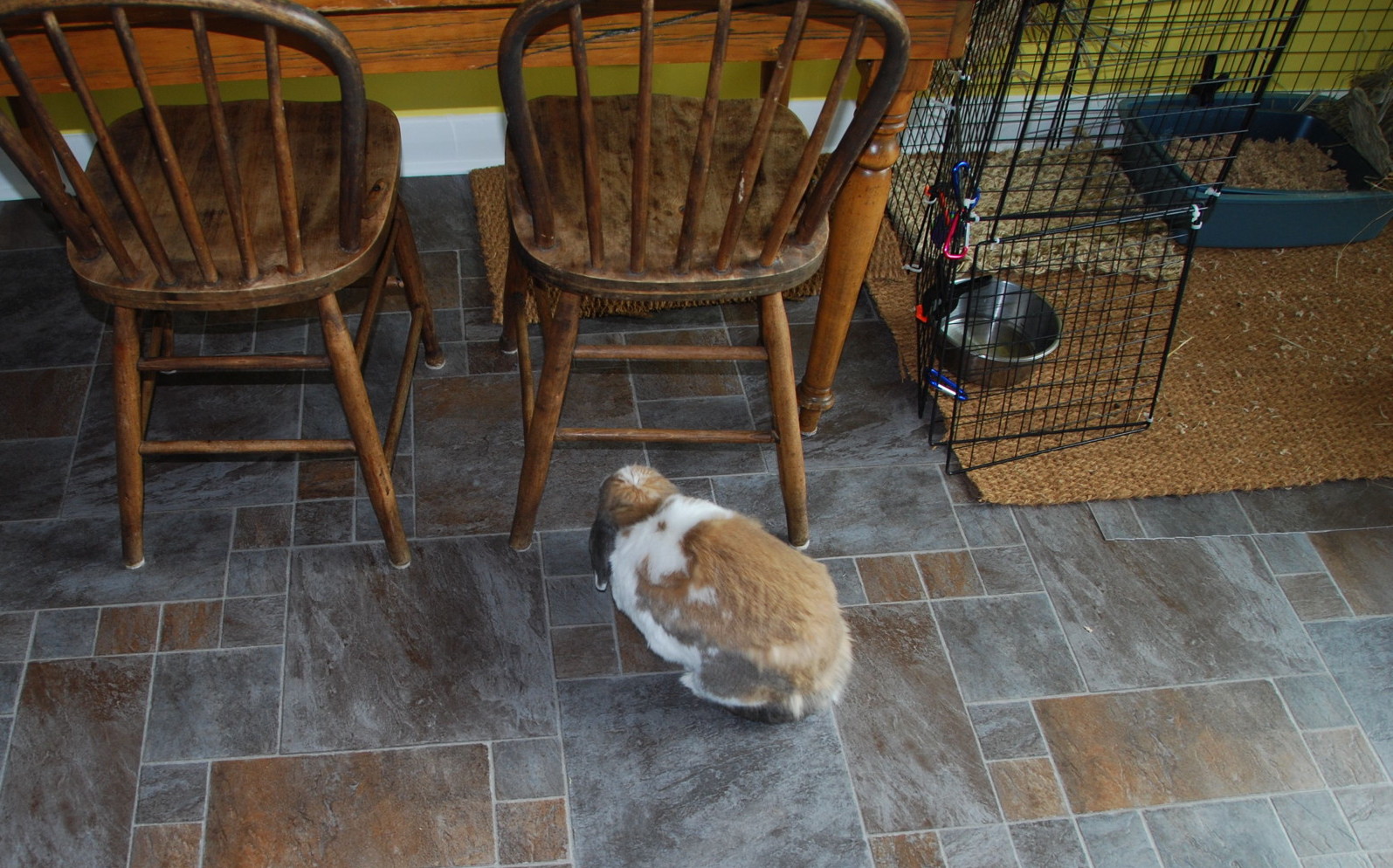
The stove is in, Hazel's pen has been rebooted, and she has been let out to scamper around the new floor and get reacquainted with the furniture. Sharing a kitchen with a rabbit might not be everyone's cup of tea but it is manageable and allows us to spend more time with her than we might otherwise.

Also, the kitchen opens onto our back deck and I have been known to let Hazel out occasionally to enjoy the great outdoors. Catherine is disinclined to do so, put off by the incessant self-scratching behavior of our rodent visitors.

Saturday, March 02, 2013

First light

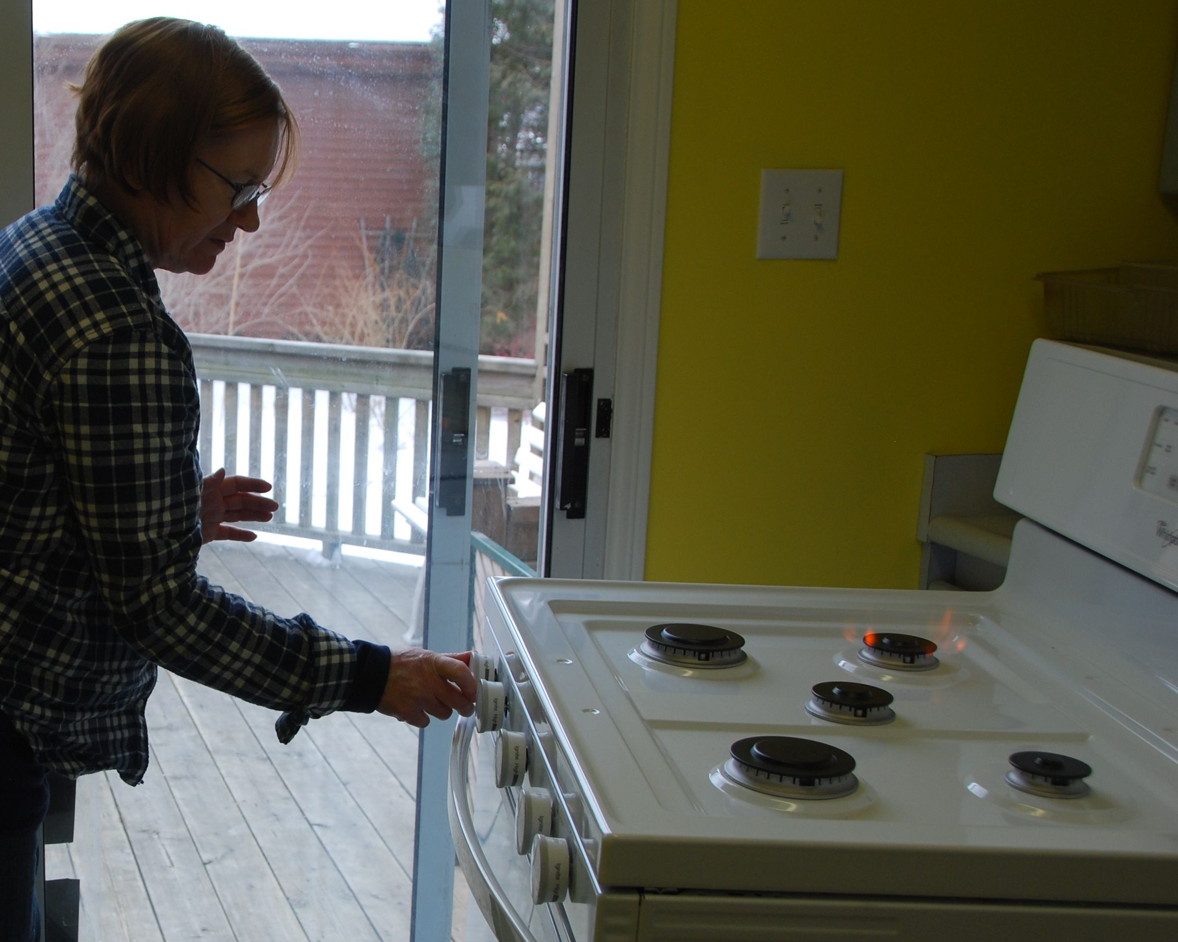
Our kitchen makeover involved painting the walls, laying down a new floor, and installing a new stove. Here is Catherine lighting it. It still needs to be pushed back into its space between the cabinets but we will wait for help so as not to scratch the floor.

The oven part of our previous stove had not been used in a very long time because, many years ago, mice had gotten into it and made it their abode. Catherine has been using a mini-oven to do her baking since but I have not done any baking at all, which is a shame because I used to make some decent cakes. I will have to bake one for Catherine's upcoming birthday!