Monday, November 14, 2016

Fear of height


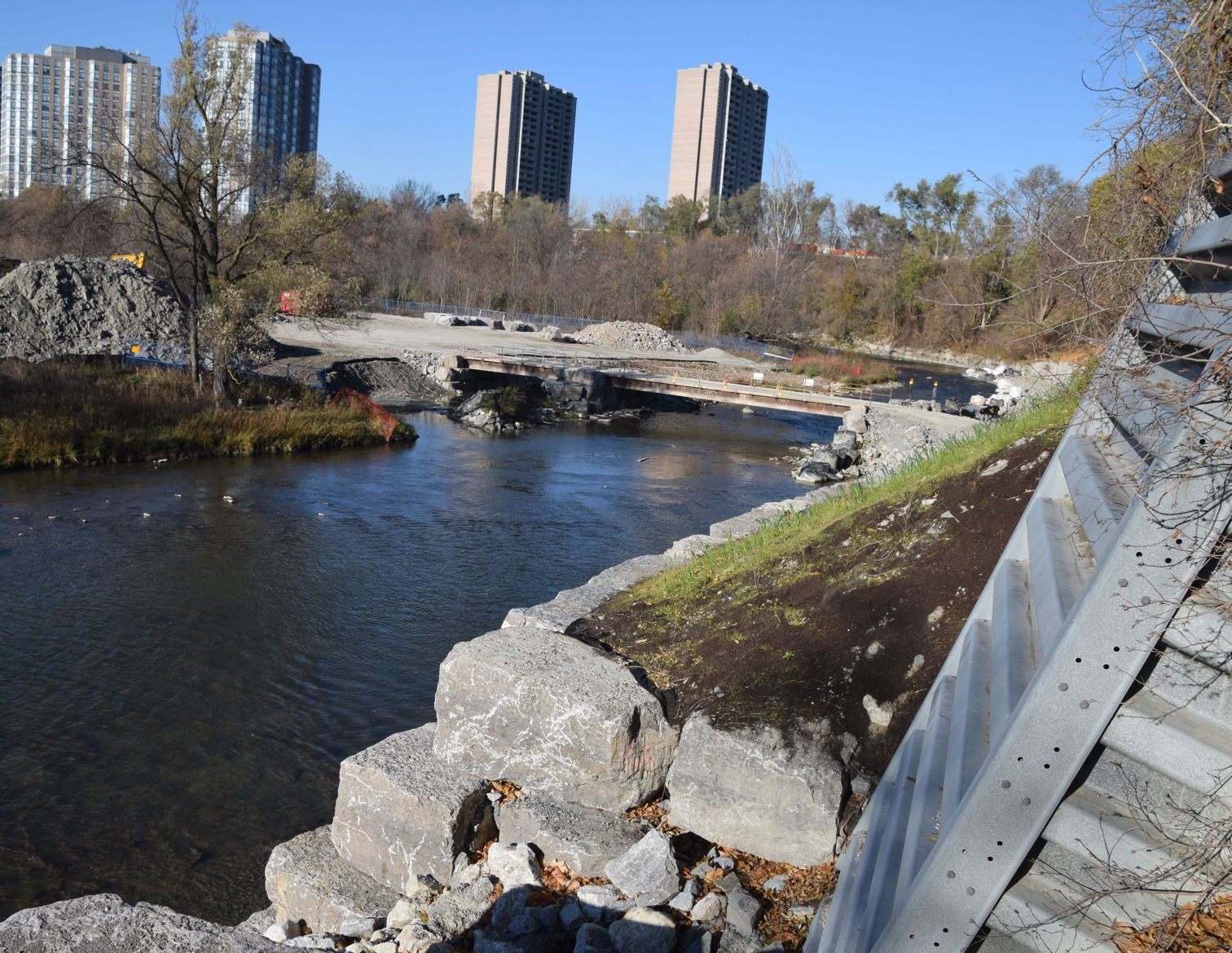
The Humber river retaining wall is approaching its northern limit. In the photo (above), the house at the top-right is actually at the end of the street on which I live. Yesterday, I climbed to the top of the wall at its southern end — five meters above the (shallow) water. Here are two pictures taken from that vantage — looking across to the other side of the river, and towards the north:


 It didn't feel the least bit safe and I was glad to climb down again.

Saturday, November 05, 2016

More 3-balanced factorization integers

Four weeks ago I discovered what I now know to be the smallest base-ten 3-balanced factorization integer. By the end of October I had completed my base-ten k-balanced list to 10^12 and decided to extend the search to 1.5 * 10^12, thus including (when finished) the first of the four 13-digit 2-balanced factorization integers. I was of course also hoping for more (small) 3-balanced examples. Yesterday and today one of my processors found these (which thusly become the second-, third-, and fourth-smallest):

1045675984884 = 2^2 * 3 * 17 * 67 * 103 * 359 * 2069
1046959786860 = 2^2 * 3 * 5 * 13 * 43 * 2087 * 14957
1047697856460 = 2^2 * 3^2 * 5 * 109 * 347 * 153889

My ill-fated, eight digits reverse search is now back on track, though I realize that it will take a good while to complete. It will rediscover the twenty-one 12-digit 2-balanced factorization integers and — more excitingly — has already come up with a k-balanced solution for k > 2.

Sunday, October 30, 2016

Weston's John Street pedestrian bridge


On Friday, the John Street UP/GO rail crossover was, at long last, opened to the public. Historically, this location may be considered to be the heart of Weston because it is where its train stations (CNR, CPR) used to be. Architecturally, I thought the bridge to be quite nice.


Although the safety fencing gets in the way of on-the-bridge photography, I was able to find a lower platform that provided an unobstructed view of the new train station to the south:


Sunday, October 09, 2016

A small 3-balanced factorization integer

My eight digits reverse search has run into unexpected and unwelcome difficulties. I have put it on a back burner for now. The forward search to 10^12 continues on several fronts and, today, snagged on one of those fronts a 12-digit 3-balanced factorization integer! In my mind I had conjectured a 13-digit 3-balanced factorization integer but a 12-digit find came as a total surprise. This answers my query as to the existence of a 3-balanced integer smaller than the largest 2-balanced integer:

785984586660 = 2^2 * 3^2 * 5 * 7 * 13 * 149 * 307 * 1049

Wednesday, September 28, 2016

So long, Teksavvy

On 17 September I experienced a significant outage on my Teksavvy internet feed. When it finally came back, I rebooted the modem, noticed that my domain no longer pointed to my computer, and made the change to the new IP address at DynDNS. I then sent an email message to an acquaintance. I have an automatic BCC to myself to let me know that messages are in fact being sent — and this one was not. So I tried some more test messages, none of which were being delivered!

Two days later, the situation had not resolved itself and I Gmailed Teksavvy support for help. After the usual security clearance, they sent me a long questionnaire — meant to rule out some obvious causes of failure. Some of the directions in that questionnaire made it obvious that they had no more than a passing acquaintance with Apple OS X and, along with my answers, I expressed: "I'm a little concerned about your lack of Mac experience as evidenced by several mistakes in using-the-terminal instructions. Other OS X references are stale at best. The current OS X is 10.12 and the location of the 'Network Utility' hasn't been where you say it is for some two years!"

On 26 September, they finally opened a ticket with their "Tier 2" department. This meant, I suppose, that this was not an obvious failure and they were prepared to take my issue seriously. What followed was an attempt to have me send a message in something other than Apple Mail because they were able to send something (using my account) by way of Microsoft Outlook. And I did manage eventually to send something using Mozilla Thunderbird, so it was (obviously) only a problem with the Apple Mail program.

Well, not so fast. On 25 September I had created an email account with Bell. The setup was straightforward and my first message — using Apple Mail — arrived at its destination immediately. Nothing wrong with Apple Mail! From Teksavvy's perspective, all I had to do to fix my problem was ditch Apple Mail. From my perspective, that was never going to happen. I've been using Apple Mail for some fourteen years. I've been using Teksavvy for five years. So long.

Wednesday, September 21, 2016

13-digit 2-balanced factorization integers

When I introduced my k-balanced factorizations last month, I noted that there were over 13000 of the 2-balanced variety. My effort to chart them all is proceeding slowly, with a couple of months yet to go before I reach 10^12. In the meantime I decided to have a try at the ones greater than 10^12. This can be accomplished by brute-forcing all possible ways of creating a valid factorization using seven or fewer digits. I generated no solutions for one to four digits. For five digits, one gets the 4 solutions of the known 1-balanced factorizations (that started it all):

        26487 = 3^5 * 109
        28651 = 7 * 4093
        61054 = 2 * 7^3 * 89
        65821 = 7 * 9403

For six digits, there are again no solutions. For seven digits, there are 4 solutions:

1495476527089 = 83^2 * 601^3
3392164558027 = 7^9 * 84061
8789650571264 = 2^31 * 4093
9418623046875 = 3^9 * 5^10 * 7^2

These then are (necessarily) the largest 2-balanced factorization integers! I'm going to run the program again for eight digits. This will generate all 12-digit 2-balanced factorization integers and may do so (I'm hoping) in less time than my exhaustive forward search. In addition, there's a chance that it may find a k > 2 solution, since nothing in the reverse search precludes it.

Monday, September 19, 2016

Eastern milk


The only snakes I have ever seen here in Toronto are garters. So when I came across this deceased (note the ants) juvenile by the curb in the road, I had to look up what kind it was. I have since been told that an adult eastern milk snake was spotted by a homeowner across the street from this scene. That person's home is right above the new retaining wall on the Humber river. So this snake's habitat has been disrupted by the construction, resulting in its being noticed where it might otherwise never have ventured. Hopefully it survives.

Thursday, September 15, 2016

Curb your enthusiasm


The sealant in the expansion joint between a sidewalk-proper and its curb degrades over time, allowing a few hardy species to gain a foothold. I assume there's a root system that manages to find its way beneath the concrete. Gotta love these plants!

Sunday, August 28, 2016

A factorization balancing act

A couple of weeks ago, Claudio Meller presented 26487 and 65821 as examples of the property of having one each of the base-ten digits when combined with the digits of their respective factorizations. Surprisingly, he missed two:

    26487 = 3^5 * 109
    28651 = 7 * 4093
    61054 = 2 * 7^3 * 89
    65821 = 7 * 9403

I wondered how this might be turned into a sequence. Base-ten k-balanced factorization integers: The combined digits of an integer and its factorization primes and exponents contain exactly k copies of each of the ten digits. So,

 45849660 = 2^2 * 3 * 5 * 19 * 37 * 1087
 84568740 = 2^2 * 3 * 5 * 67 * 109 * 193
104086845 = 3^2 * 5 * 19 * 23 * 67 * 79
106978404 = 2^2 * 3 * 13 * 685759

and so on. For any given k, k-balanced integers are necessarily finite. For k=2, there are a little over 13000. Is the largest of these greater than the smallest 3-balanced integer?

It's not too difficult to generate very large terms:

345655692176023955231233047798293565182493067678373538829683596019374251932061880049408412541410264671864570007449201127

is an example of a 13-balanced integer. Can you come up with a larger one?

Saturday, August 06, 2016

My 100th Leyland prime find


Last October I found my first previously unknown Leyland (probable) prime. Today I found my 100th. The graph shows (in order of discovery) the number of decimal digits of those 100 primes, ranging from 43633 to 61184. The finds have had the unintended (but certainly not unpleasant) consequence of pushing me up a list of probable prime contributors! My search for Leyland primes is of course in aid of my Leyland prime indexing effort which has reached #1137. There'll be a significant jump in about three weeks when I finish rounding up the few remaining unknowns with decimal digit lengths of between 54334 and 55390.